Jaggery vs Sugar: Is Gur Actually the Healthier Sweetener?
Key takeaways
- Jaggery and refined sugar contain nearly the same calories per 100g, and both are still added sugar as far as your body is concerned.
- Jaggery does carry real trace minerals like iron and potassium that refined sugar lacks almost entirely — but the amount in a typical serving is too small to meaningfully affect your daily intake.
- Some research suggests jaggery may actually raise blood sugar faster than white sugar, not slower, so it isn't automatically the safer choice for blood sugar control.
- Both NHS and WHO guidance treats jaggery the same as any other added sugar when it comes to daily limits.
- Jaggery's real value is cultural and culinary, not a health upgrade — it's worth keeping in your kitchen for taste and tradition, not as a health food swap.
Growing up in India, jaggery was never really a “health food” — it was just what went into your tea some mornings, or what your grandmother’s generation swore by after a heavy meal. It’s only in the last few years, watching wellness accounts online, that I started seeing gur repackaged as the “healthy sugar.” That claim is worth actually checking against the numbers, not just repeating because it sounds nice.
What jaggery actually is
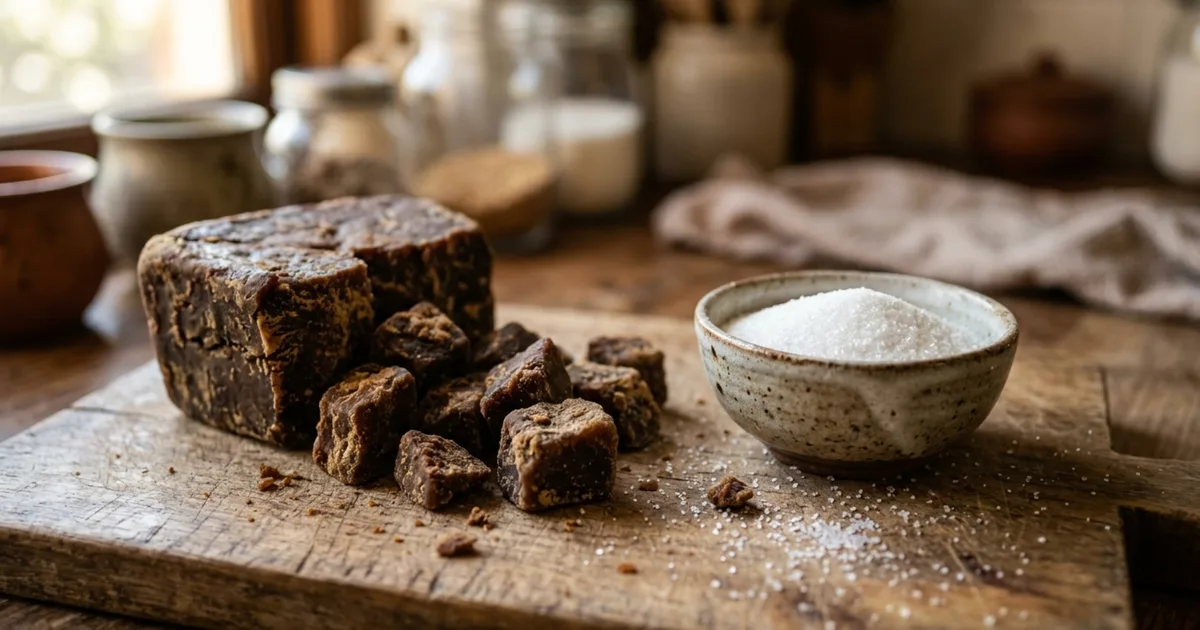
Jaggery is unrefined sugar. Sugarcane juice (or sometimes palm sap) is boiled down and reduced until it solidifies into a block or granulated form, with nothing removed from it along the way. Refined white sugar starts from the same sugarcane juice, but goes through a processing stage that strips out the molasses, plant fibre, and trace minerals, leaving behind pure crystallised sucrose.
That difference in processing is the entire basis of jaggery’s reputation. Because nothing is stripped out, jaggery retains small amounts of the minerals naturally present in sugarcane juice — iron, potassium, calcium, magnesium — none of which survive the refining process that produces white sugar. The question is whether that retained mineral content is actually enough to matter.
The mineral content claim, checked with real numbers
This part of the claim is genuinely true, but it needs an honest amount of context. Reported values for jaggery vary fairly widely depending on the source of the cane and how it’s processed, but iron content is typically cited somewhere in the range of 2–11mg per 100g, with potassium commonly reported in the low hundreds of milligrams per 100g. Refined white sugar, by contrast, contains essentially no iron, potassium, or any other mineral — it’s close to 100% sucrose with nothing else attached.
So on paper, jaggery wins by a wide margin. In practice, the amount that matters is what you actually eat, and nobody eats 100g of jaggery in a sitting. A typical serving — a teaspoon or a small piece stirred into tea, or used to sweeten a dessert — is closer to 5–10g. At that scale, even the higher iron estimates put you at well under 1mg of iron, against a daily requirement of 8.7mg for adult men and post-menopausal women, and 14.8mg for women aged 19–49, according to NHS guidance on iron. That’s a meaningful gap. Jaggery isn’t a reliable source of iron at the quantities anyone actually consumes it in, and treating it as one risks under-addressing a real iron deficiency with a sweetener instead of food or supplementation that can actually close the gap.
None of this makes the mineral content fake. It’s real, and if you’re going to use a sweetener anyway, jaggery genuinely does contribute something white sugar doesn’t. It just isn’t enough, at normal serving sizes, to call it a meaningful source of any nutrient on its own.
Calories: essentially no difference
If you’re comparing jaggery and sugar hoping one is meaningfully lower in calories, the numbers don’t support that either. Refined sugar comes in at roughly 387 calories per 100g, and jaggery sits close behind at approximately 383–390 calories per 100g depending on moisture content. Gram for gram, they’re close enough that the difference disappears at any serving size you’d actually use. If weight management is the reason you’re choosing between the two, this comparison won’t move the needle — the calories are the same conversation either way.
The glycemic index question — and why “natural” doesn’t mean “slower”
This is the part of the popular claim that surprised me most when I actually looked into it. The common assumption is that because jaggery is less processed, it must release sugar into your bloodstream more slowly than refined sugar. Research doesn’t support that assumption, and in some cases points the other way.
Jaggery is roughly half sucrose, with a meaningful share of invert sugar — glucose and fructose that have already been split apart. Free glucose is absorbed and raises blood sugar faster than intact sucrose, which your body has to break down first. That’s the likely reason some research comparing jaggery, sucrose, and honey in people with diabetes found jaggery’s glycaemic index to be higher than sucrose’s, not lower — a finding that runs directly against the “jaggery is gentler on blood sugar” claim you’ll see repeated online. This is genuinely an area where more high-quality research would help settle the question with more confidence, but the existing evidence gives no solid basis for treating jaggery as the safer option for blood sugar control. If you manage diabetes or prediabetes, there’s no good reason to assume gur is a free pass that white sugar isn’t.
Where jaggery genuinely earns its place — as tradition, not medicine
None of this means jaggery deserves to be thrown out. In Indian households, jaggery has a long-standing role that has nothing to do with being a health supplement: a small piece after a meal as a traditional palate cleanser, a spoonful in tea through the colder months, a standard ingredient in postpartum food traditions and winter sweets. That’s cultural and culinary context worth respecting on its own terms — I still keep a block of jaggery in my kitchen for exactly these reasons. What it isn’t is a clinically supported digestive aid or a treatment for anything specific, and there isn’t solid research behind the idea that jaggery “aids digestion” in a way plain sugar doesn’t. Enjoying it as part of how you were raised to eat is a perfectly good reason to keep using it. Just don’t let that reason quietly turn into a health claim it can’t back up.
How to actually think about the choice
If you’re deciding between jaggery and white sugar, the honest framing is this: they’re both added sugar, and your body treats them close to identically once they’re absorbed. Jaggery brings a small nutritional bonus in the form of trace minerals and a deeper, more complex flavour that works beautifully in tea, desserts, and traditional recipes. White sugar is more neutral and dissolves more predictably in baking and precise recipes. Neither one gives you license to use more of it because it feels like the “clean” choice.
My tip: I use jaggery when the flavour genuinely calls for it — chai, kheer, a winter laddoo — and I don’t pretend I’m doing it for my iron levels. If iron is actually a concern for you, lentils, leafy greens, and lean meat will do far more for you than any sweetener will.
Both the NHS and WHO treat all free sugars the same way in their guidance, regardless of source — jaggery, honey, syrups, and table sugar are all counted together. The NHS recommends adults keep free sugar intake under 30g a day, and the WHO recommends free sugars stay below 10% of total energy intake, with additional benefit below 5%. Jaggery isn’t exempt from either limit just because it started as unrefined cane juice.
Frequently asked questions
Is jaggery actually healthier than sugar?
Not in any way that changes how you should eat it. Jaggery contains trace minerals refined sugar doesn’t, but at normal serving sizes those amounts are too small to matter nutritionally, and some research suggests jaggery may raise blood sugar faster than sugar, not slower. Both count as added sugar and should be limited the same way.
Does jaggery help with iron deficiency?
Not meaningfully. Even generous estimates of jaggery’s iron content put a typical teaspoon-sized serving at well under 1mg, against a daily requirement of 8.7–14.8mg depending on age and sex. If you’re addressing an iron deficiency, iron-rich foods or a supplement recommended by your doctor will do far more than switching sweeteners.
Does jaggery have a lower glycemic index than sugar?
The evidence doesn’t support that claim, and some research found the opposite — jaggery’s glycaemic index measured higher than sucrose’s in comparative studies. There’s no solid basis for assuming jaggery is gentler on blood sugar than white sugar.
Can people with diabetes eat jaggery instead of sugar?
Not on the assumption that it’s safer. Both raise blood sugar, and jaggery has shown no consistent advantage over sugar in blood sugar response. If you have diabetes, treat jaggery with the same portion awareness you’d apply to sugar, and talk to your doctor or dietitian about how it fits your specific plan.
Why do people say jaggery is good after meals or in winter?
This comes from long-standing Indian food tradition rather than clinical research — a small piece after a meal as a customary palate cleanser, or in winter recipes for warmth and flavour. It’s a genuine cultural practice worth continuing for its own sake, but it isn’t backed by evidence as a digestive treatment.
How much jaggery or sugar is safe to eat per day?
NHS guidance recommends adults keep free sugars — which includes jaggery — under 30g a day, and WHO guidance recommends keeping free sugars below 10% of total daily energy intake, with extra benefit below 5%. These limits apply to jaggery the same way they apply to any other added sugar.
References
- Guideline: Sugars intake for adults and children — World Health Organization, 2015.
- WHO calls on countries to reduce sugars intake among adults and children — World Health Organization, 2015.
- Sugar: the facts — NHS.
- Iron — Vitamins and minerals — NHS.
Found this helpful?