How to Build Habits That Actually Stick
Key takeaways
- The popular "21 days to form a habit" claim isn't well supported — a landmark UK study found a median of 66 days, with a real range of 18 to 254 days depending on the person and habit.
- That range matters more than the average: a habit that takes you 100 days isn't a personal failure, it's within normal, studied variation.
- Attaching a new habit to an existing one you already do reliably — an "anchor habit" — is a well-documented technique for making a new behaviour easier to remember and repeat.
- Starting smaller than feels meaningful is a genuine strategy, not a compromise — a habit you can actually repeat on a bad day is more valuable than an ambitious one you abandon after a week.
- We've had far more success anchoring a new habit to something we already do daily without thinking, than trying to remember it cold.
The idea that a habit takes 21 days to form gets repeated so often it sounds settled — but it traces back to a 1960s plastic surgeon’s informal observation about patients adjusting to a new appearance, not a controlled study of habit formation at all.
What the real research actually found
A landmark study from University College London had 96 volunteers choose a daily habit — an eating, drinking, or activity behaviour — and tracked how automatic it felt over 12 weeks. The headline finding was a median of 66 days to reach near-peak automaticity, not 21. Just as importantly, the range across participants was wide: 18 to 254 days, depending on the specific person and specific habit. There isn’t one universal timeline — there’s a genuinely wide, normal range, and 66 days is the middle of it, not a target everyone should expect to hit.
Why the range matters more than the average
Knowing the real number is only useful if it changes what you do with a hard week. If a new habit still feels effortful after a month, that’s not evidence it isn’t working — a full month is still well within the low end of the real studied range. The 21-day myth sets people up to feel like they’ve failed right around the point where, per the actual research, plenty of people are still entirely on track.
The technique that actually helps: anchoring
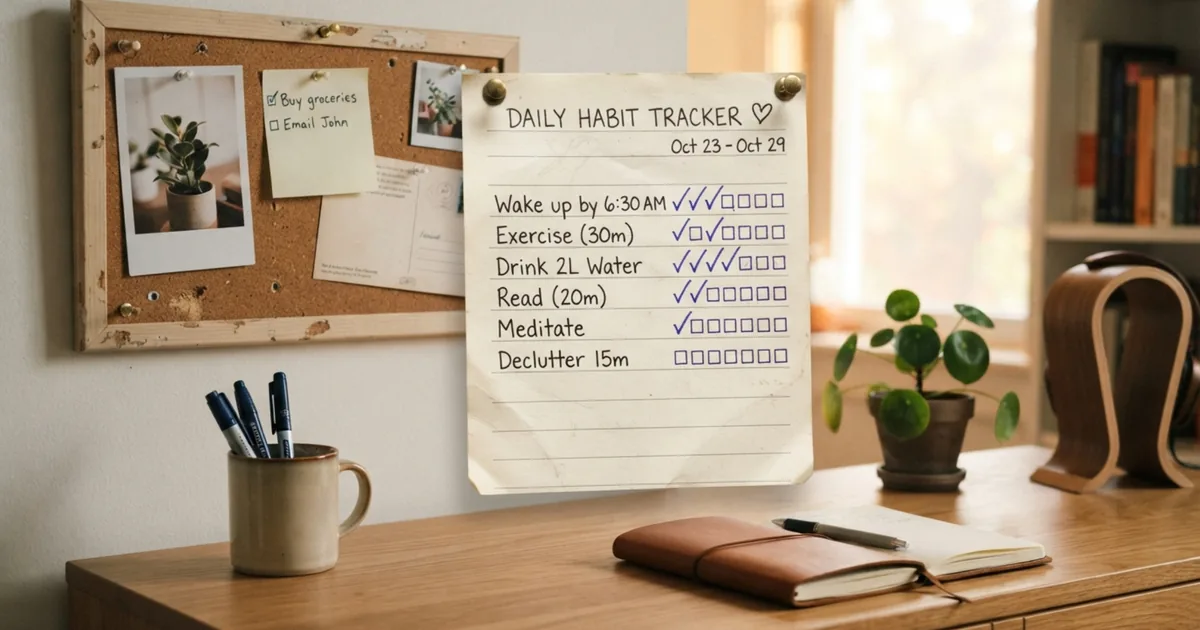
One well-documented approach — often called an anchor habit — is attaching a new behaviour to something you already do reliably, rather than trying to remember it as a standalone task. The structure is simple: after [existing habit you already do without fail], do [new habit]. The existing habit acts as a built-in reminder, so the new one doesn’t rely purely on willpower or memory, which are exactly the two things that run lowest on a hard day. It’s the same principle behind stimulus control for sleep — consistently pairing a behaviour with a fixed cue, rather than relying on remembering it cold, is what makes it automatic over time.
Start smaller than feels worth it
The instinct is to start with a version of the habit that feels meaningfully impressive — a full workout, a full page of journaling, a fully cooked-from-scratch dinner every night. A smaller starting version — one you could still do on a genuinely bad day — is more likely to survive long enough to become the automatic thing the research is describing. Consistency matters more than intensity for exactly this reason; a habit that gets skipped whenever life gets hard never accumulates the repetition it needs to become automatic in the first place.
What this has looked like for us
The habit that’s actually stuck for us wasn’t the one we tried hardest to remember — it’s the one we anchored to something we were already doing every single day without thinking about it. Moving our evening walk to right after dinner, instead of “sometime in the evening,” turned it from a decision we had to make daily into something that just happens because dinner just happened.
My tip: Pick the smallest honest version of the habit you’re trying to build, and anchor it to something you already do every single day without fail — not something you’re hoping to also start doing. Two new habits stacked on each other are both more fragile than one new habit stacked on something solid.
Frequently asked questions
Does it really take 66 days to build a habit?
That’s the median from a real UK study, but the actual range was 18 to 254 days depending on the person and the specific habit — 66 days is the middle of a wide, normal range, not a fixed target.
Is the “21 days to form a habit” idea just wrong?
It’s not well supported by research — it traces back to informal observations, not a controlled study of habit formation, and real research puts the median closer to 66 days.
What’s an “anchor habit” and why does it help?
It’s attaching a new habit to an existing one you already do reliably, using the structure “after [existing habit], I do [new habit].” The existing habit acts as a built-in reminder, reducing reliance on memory or willpower alone.
Should a new habit start big or small?
Small. A smaller version you can realistically repeat even on a bad day is more likely to survive long enough to become automatic than an ambitious version that gets skipped whenever life gets busy.
What does it mean if a habit still feels effortful after a month?
It doesn’t mean it isn’t working — a month is still within the low end of the real range found in research. Automaticity for many people takes considerably longer than that.
References
- Lally, P. et al. How are habits formed: Modelling habit formation in the real world. European Journal of Social Psychology, 2010. onlinelibrary.wiley.com
Found this helpful?