The Mental Load, Broken Down: A Practical System
Key takeaways
- Every household task actually has three separate parts: Conception (realising it needs doing), Planning (figuring out how), and Execution (doing it) — a framework popularised by author Eve Rodsky after original research with over 500 couples.
- Splitting tasks 50/50 by count often still leaves the mental load unbalanced, because one partner can end up doing all three parts (Conception, Planning, Execution) of most tasks while the other only executes.
- What tends to matter most for relationship satisfaction isn't a perfect 50/50 split — it's whether each partner fully owns some tasks from start to finish, rather than one partner managing everything and delegating pieces.
- A task genuinely isn't "done" by one partner if the other partner is still the one remembering it needs doing and checking it happened — that's still mental load, even if someone else did the physical part.
- This article is a practical companion to naming the mental load — see our piece on the underlying research for what it actually is and why it's hard to see.
Naming the mental load is the easy part. Actually redistributing it is harder, and most advice stops right at the naming, without a practical way to change who’s carrying it.
The three parts of every task
A useful framework, developed by author Eve Rodsky after original research with more than 500 couples, breaks every household task into three separate parts: Conception (realising something needs to happen — the diaper supply is running low), Planning (figuring out how — deciding what to buy, where, by when), and Execution (actually doing it — buying the diapers). Most task-splitting only counts Execution. The other two parts are the actual mental load, and they’re invisible on any simple chore list. Weekly meal planning is a clean everyday example of a task that’s almost entirely Conception and Planning — the actual cooking is the smallest part of the real work.
Why a 50/50 split can still feel unbalanced
This explains a genuinely common, confusing pattern: two partners can split the doing of tasks quite evenly and one can still feel like they’re carrying nearly everything. If one partner handles Conception and Planning for most of the household — noticing what’s needed, deciding how, then just assigning the Execution — that partner is still doing the real cognitive work, even if the physical task count looks even on paper. A task assigned and then executed by someone else isn’t the same as a task that person fully owns.
What actually seems to help
The research behind this points to something specific: satisfaction tends to depend less on a perfect numeric split, and more on whether each partner fully owns some tasks — meaning they handle the Conception and Planning too, not just the Execution of something someone else has already figured out. A partner who’s told “the diapers need buying” is executing. A partner who notices the diapers are running low, decides when to buy them, and buys them is doing the whole task, unprompted — and that’s the version that actually reduces the load on the other person, not just the visible chore count.
A test worth using
A genuinely useful check: is this task actually “off your plate,” or are you still the one remembering it needs doing and checking it got done? If you’re still tracking it in the background, even if someone else executed it this one time, the mental load hasn’t actually moved — only the physical action has. This distinction is the practical version of the research on why mental load stays uneven even in couples who divide tasks evenly on paper.
What this has looked like for us
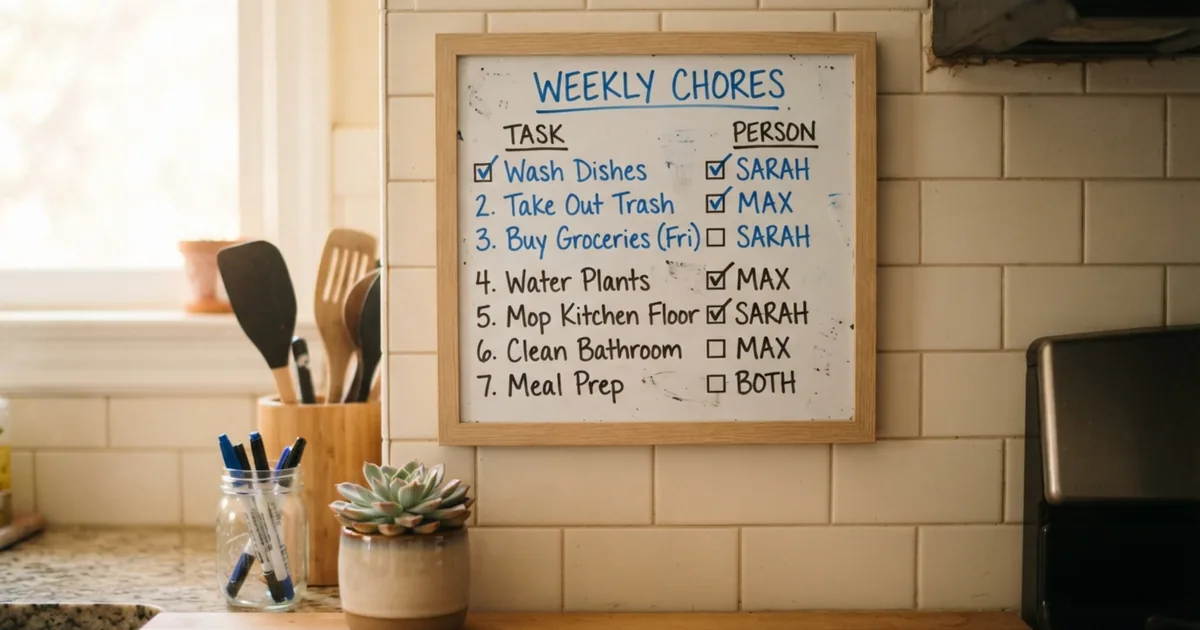
What’s genuinely shifted things for us wasn’t a chore chart — it was explicitly handing over full ownership of specific categories, Conception through Execution, rather than dividing individual tasks. One of us fully owns certain recurring categories start to finish; the other fully owns different ones. Neither of us has to remember the other’s categories exist, which is the actual point — remembering is the load, not just the doing. The same “state it as your own, not a request” framing that helps with boundaries outside the household works here too — “I own this” is clearer than “can you handle this.”
My tip: Before assuming a task is evenly shared, ask who would notice if it didn’t get done this week — not who did it last time. That answer, more than any chore count, tends to reveal where the mental load actually sits.
Frequently asked questions
What is the Conception-Planning-Execution framework?
It breaks any household task into three parts: Conception (realising it needs doing), Planning (deciding how), and Execution (doing it). Most chore-splitting only counts Execution, which is why a 50/50 task split can still leave the mental load unbalanced.
Why can a household still feel unbalanced even with an even chore split?
Because splitting by task count usually only measures Execution. If one partner handles the Conception and Planning for most tasks and just assigns the doing, that partner is still carrying the real cognitive load, regardless of how evenly the physical tasks are split.
What actually helps rebalance the mental load, based on research?
Full ownership of specific tasks or categories by each partner — handling Conception, Planning, and Execution together — rather than one partner managing everything and delegating individual pieces to the other.
How can you tell if a task has genuinely been handed off?
Ask who would notice if it didn’t happen this week. If you’re still the one tracking whether it got done, the mental load hasn’t actually moved, even if someone else carried out the physical task.
Is this the same as the “mental load” research discussed elsewhere on this site?
It’s a practical companion to it — our article on the underlying research explains what the mental load is and why it’s hard to see; this one focuses specifically on what’s actually helped redistribute it in practice.
References
- Rodsky, E. Fair Play: A Game-Changing Solution for When You Have Too Much to Do. Original research with 500+ couples. everodsky.com
- Daminger, A. The Cognitive Dimension of Household Labor. American Sociological Review, 2019. journals.sagepub.com
Found this helpful?