Work-Life Balance for Dual-Career Parents

Key takeaways
- Real sociological research has named and studied a specific, largely invisible category of labor — the 'mental load' — the ongoing cognitive work of anticipating, deciding, and tracking what a household needs.
- Research has found anticipation and monitoring of household needs frequently falls to one person, even in couples where physical tasks and decisions appear genuinely shared.
- Couples who practice reciprocal support and spontaneous collaboration report measurably reduced mental load and improved engagement at work — this is a real, studied effect, not just an intuitive claim.
- Flexible working arrangements are the most common organisational strategy that actually helps dual-career couples manage work and family together.
- As two working software engineers with a young daughter, this isn't abstract for us — it's the actual daily logistics of our household.
Work-life balance advice often stays vague enough to be almost useless — “set boundaries,” “communicate better” — without naming the actual, specific thing that tends to cause friction in a dual-career household with a young child.
The invisible labor that has an actual name
Real sociological research has identified and studied a specific category of household labor that’s easy to miss if you’re only counting physical tasks: the “mental load,” sometimes called cognitive or managerial labor. This isn’t the doing of a task — it’s the anticipating that it needs doing, the deciding how and when, and the ongoing tracking of what’s still unfinished. A well-known sociological study specifically distinguished this cognitive dimension from the physical execution of household tasks, and found something genuinely important: even in couples where physical tasks and even day-to-day decisions appear evenly split, the anticipation and monitoring — noticing something is running low, remembering an appointment needs booking, tracking what a child needs before it becomes urgent — often falls disproportionately to one person.
Why this distinction actually matters
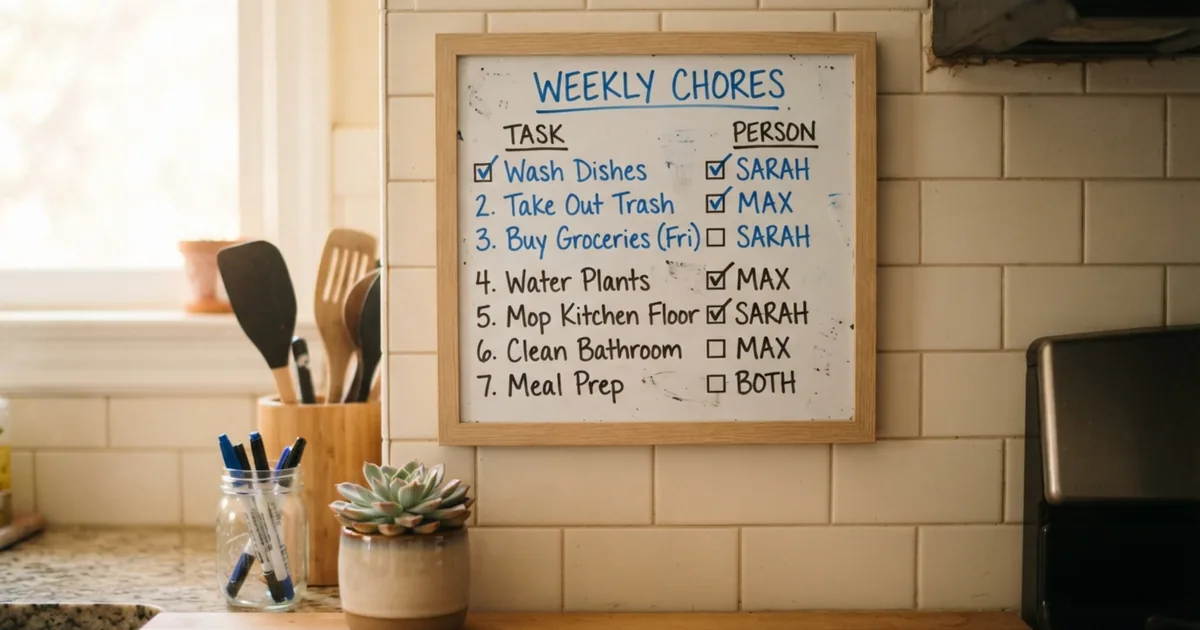
This matters practically because it explains a common, confusing experience: a couple can divide chores and even parenting tasks quite evenly on paper, while one partner still ends up carrying a much heavier overall load — because the mental load of noticing, planning, and tracking isn’t captured by a simple task list. Recognising this as its own distinct category, rather than lumping it in with “chores,” is the first step toward actually addressing it rather than just redistributing physical tasks and wondering why the imbalance persists.
What actually helps, based on research
Couples who practice genuine reciprocal support and spontaneous collaboration — rather than a rigid, fixed division where each partner only handles their own separately assigned tasks — report measurably reduced mental load and improved engagement at work as a result. This is a real, researched effect, not just an intuitive-sounding claim. Flexible working arrangements are also the most common and effective organisational factor that actually helps dual-career couples manage the combined demands of work and family, when available.
What this actually looks like for us
As two working software engineers with a young daughter, none of this is theoretical for us — it’s the actual daily logistics of the household. What’s genuinely helped is naming the mental load explicitly between us, rather than assuming it’s obvious or that dividing physical tasks alone would be enough — actively talking about who’s tracking what, not just who’s doing what. Staying deliberately flexible rather than rigid about the day-to-day details, while being consistent about the few things that mattered most, carried over from parenting a newborn into how we manage work and household logistics together now.
Naming it is only the first step — a practical framework for actually redistributing it, not just discussing it, is what’s helped us turn this from an ongoing conversation into an actual change.
What this doesn’t mean
None of this means physical division of labor doesn’t matter — it clearly does. It means physical division alone isn’t the full picture, and a couple that’s stuck on “we already split everything evenly” while one partner still feels overwhelmed may be missing this specific, well-documented invisible layer rather than imagining a problem that isn’t real. Chronic overload from an uneven mental load can also show up as stress-driven eating patterns or disrupted sleep — worth recognising as connected, not separate, issues.
Frequently asked questions
What exactly is the “mental load”?
It’s the ongoing cognitive work of anticipating what a household needs, deciding how to address it, and tracking what remains unfinished — distinct from actually doing the physical tasks themselves. Real sociological research has specifically studied and named this as its own category of labor.
Can a couple split chores evenly and still have an imbalanced mental load?
Yes — research has found this is a common pattern. Anticipation and monitoring of household needs frequently fall to one person even when physical tasks and decisions appear genuinely shared.
What actually helps reduce an uneven mental load?
Research points to reciprocal support and spontaneous collaboration, rather than a fixed division where each partner only handles pre-assigned tasks — couples who practice this report measurably reduced mental load and improved work engagement.
Does flexible work actually make a real difference for dual-career parents?
Yes — it’s identified as the most common and effective organisational factor that helps dual-career couples manage combined work and family demands, where it’s available.
Is this only relevant to some households, or is it a genuinely common pattern?
It’s a genuinely common, well-documented pattern across dual-career households, not a niche or unusual issue — which is part of why naming it explicitly, rather than assuming it’s obvious, tends to help.
References
- Daminger, A. The Cognitive Dimension of Household Labor. American Sociological Review, 2019. journals.sagepub.com
Found this helpful?