Meal Planning for a Busy Household
Key takeaways
- A large study of over 40,000 French adults found meal planning was associated with more varied diets, better adherence to nutritional guidelines, and lower rates of obesity.
- "What's for dinner?" is often less about the cooking itself and more about decision fatigue — making the same low-stakes-but-draining choice every single evening.
- A workable weekly plan doesn't need to be rigid or elaborate — a short list of realistic dinners, decided once, removes the daily re-deciding.
- Planning around what you already have and genuinely eat, rather than an idealised version of your diet, is what makes a plan survivable on a hard week.
- We keep our own plan loose on purpose — a rough shape for the week, not a locked schedule — because a plan that breaks the first time life gets messy stops being useful.
The question isn’t really “what’s for dinner” — it’s “what’s for dinner” asked fresh, from zero, at 6pm, after a full day of other decisions. That repeated small decision is often the actual source of the dread, more than the cooking itself.
What the research actually shows
A large study of over 40,000 adults, published in the International Journal of Behavioral Nutrition and Physical Activity, found that people who planned their meals ahead of time ate a more varied diet, followed nutritional guidelines more closely, and had lower rates of obesity than people who didn’t plan. The study didn’t try to prove planning causes better eating on its own — but the association held up even after accounting for other factors, which is a meaningfully strong signal for something this simple.
Why the daily version is the exhausting one
Deciding what to cook isn’t a hard decision in isolation — it’s a low-stakes decision made repeatedly, at the end of the day, when there’s the least mental energy left to make it well. That’s decision fatigue: the quality and ease of decision-making measurably declines the more decisions you’ve already made that day, even ones as small as picking a meal. A weekly plan doesn’t remove the decision — it just moves it to a single moment when there’s more energy available to make it, instead of re-litigating it seven times under worse conditions. It’s the same underlying logic behind why the mental load of a household falls unevenly even when physical tasks are shared — the deciding is its own real cost, separate from the doing.
What actually holds up on a real week
A meal plan only works if it survives contact with an actual busy week, not a hypothetical calm one. What’s worked for us is planning around meals we already know how to make quickly and genuinely want to eat again, rather than an aspirational version of our diet that looks good on paper and gets abandoned by Wednesday. Dal tadka and vegetable khichdi are two of our actual weekly regulars specifically because they’re genuinely fast, one-pot, and forgiving of a rough day — not because they’re exciting new recipes we’re trying out.
Keep it loose, not locked
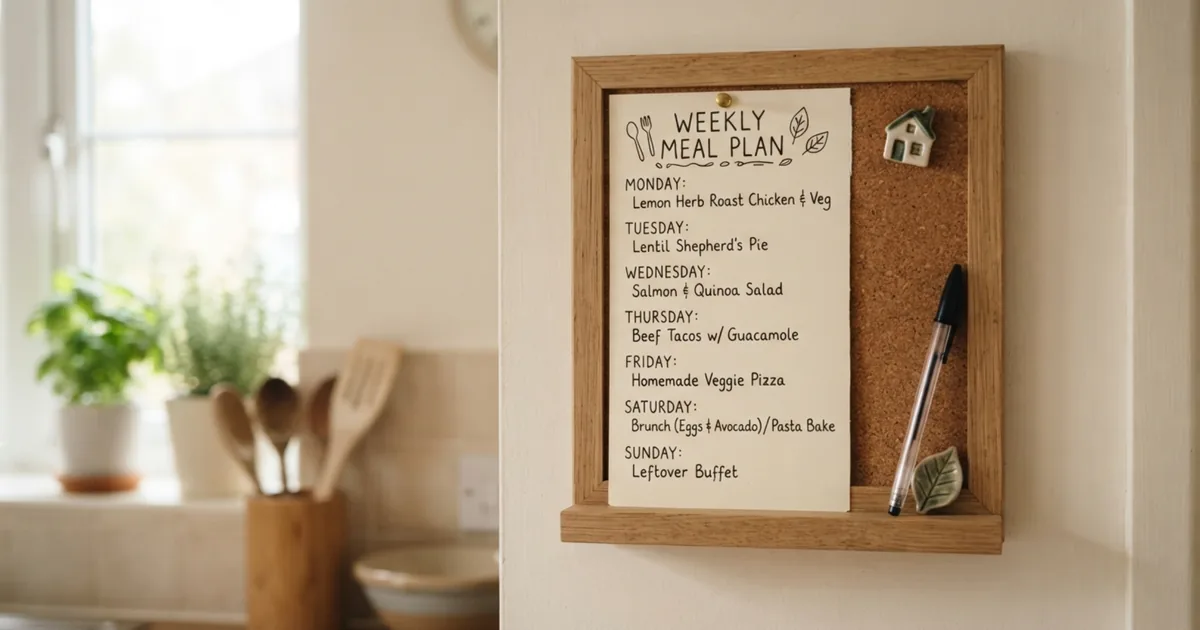
We deliberately don’t assign a fixed meal to each specific day. Instead we pick five or six realistic dinners for the week as a rough pool, and slot them in as the week actually unfolds — which means a plan that gets knocked around by a late meeting or an off day doesn’t fall apart entirely, it just reshuffles. A rigid day-by-day schedule looks tidier on a fridge whiteboard, but it’s also the first thing to break, and a broken plan tends to get abandoned rather than adjusted.
My tip: Batch the boring decision, not the boring food: pick your realistic dinner pool once a week, but let yourself decide same-day which one you’re actually in the mood for. You still get the benefit of not starting from zero every evening, without a rigid schedule fighting you when the day doesn’t go as expected.
Frequently asked questions
Does meal planning actually make a measurable difference, or is it just a nice idea?
Real research supports it — a large study of over 40,000 adults found meal planners had more varied diets, closer adherence to nutritional guidelines, and lower obesity rates than non-planners.
How detailed does a meal plan actually need to be?
Not very. A short list of five or six realistic meals for the week, decided once, is enough to remove the daily “what’s for dinner” decision — it doesn’t need to assign a fixed meal to each specific day to work.
Why does deciding dinner every night feel so much harder than it should?
It’s decision fatigue — the quality and ease of decision-making declines the more decisions you’ve already made that day, even small, low-stakes ones like choosing a meal, especially by the end of a full day.
What’s the most common way meal plans fail?
Being too rigid or too aspirational — a fixed day-by-day schedule, or a plan built around meals you don’t actually want to cook, is the first thing to break when a real week gets messy, and a broken plan usually gets abandoned rather than adjusted.
Should a meal plan include every meal of the day?
Not necessarily. Dinner tends to be the highest-friction decision for most households — planning just that one meal captures most of the benefit without adding the overhead of planning every meal.
References
- Ducrot, P. et al. Meal planning is associated with food variety, diet quality and body weight status in a large sample of French adults. International Journal of Behavioral Nutrition and Physical Activity, 2017. pmc.ncbi.nlm.nih.gov
Found this helpful?