Almonds: Real Heart Benefits, and Why Soaking Them Might Not Matter
Key takeaways
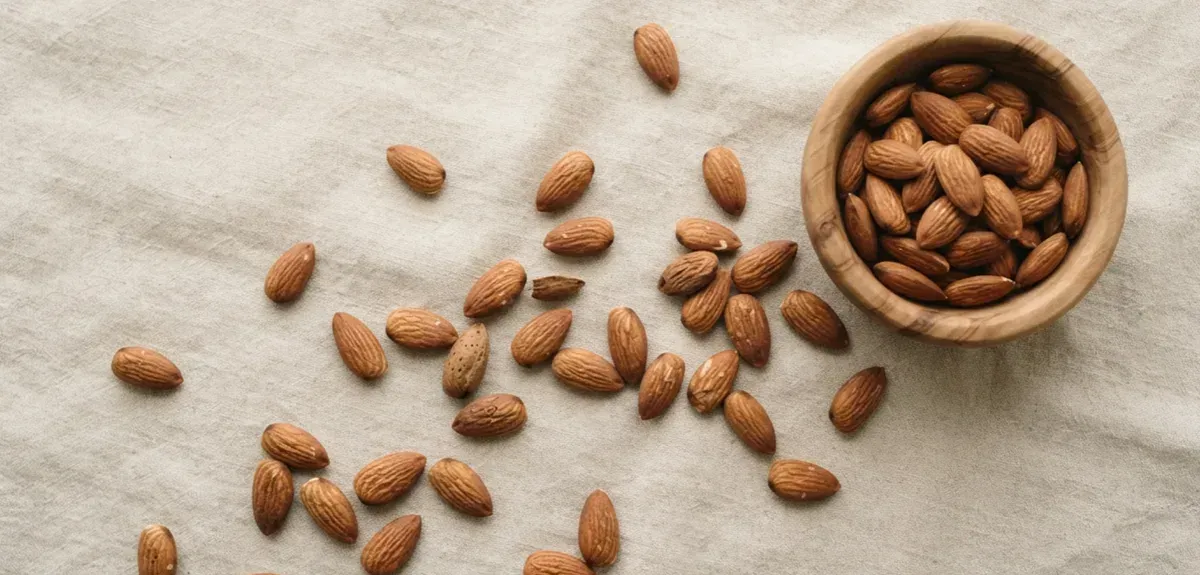
- A one-ounce serving (about 23 almonds) has 164 calories, 6g of protein, and a large share of your daily vitamin E.
- Randomised trials consistently show almonds lower LDL ('bad') cholesterol and total cholesterol without hurting HDL.
- Soaking almonds overnight — a tradition in many Indian households, including mine growing up — barely reduces phytic acid, contrary to popular belief.
- Soaking does reliably remove the bitter, tannin-rich skin, which is a real (if different) reason to keep doing it.
- Whole almonds are a genuine choking hazard for children under about 4 — offer them ground or as almond butter instead.
Source: USDA FoodData Central
Soaked almonds were a non-negotiable in my house growing up — a small bowl left in water overnight, peeled first thing in the morning, no explanation needed beyond “that’s how you eat almonds.” It wasn’t until years later, reading actual nutrition research rather than repeating the tradition, that I found out the reason most people give for soaking — better mineral absorption — doesn’t really hold up the way I’d always assumed.
What’s actually in almonds
A one-ounce serving — about 23 almonds — has roughly 164 calories, 6g of protein, 14g of fat (mostly the unsaturated kind), and 3.5g of fibre, alongside a genuinely large share of your daily vitamin E. Per 100g, that scales to 579 calories, 21g of protein, and 12.5g of fibre — dense in every sense, which is exactly why portion matters more with almonds than with, say, an apple.
The claim that’s genuinely well-supported: cholesterol
Multiple randomised controlled trials back this one up consistently. A systematic review and meta-analysis of 15 trials found almond consumption significantly lowered total cholesterol, with the effect strongest — averaging roughly 45g (about 1.5oz) a day — in people who already had elevated cholesterol to begin with. Crucially, LDL and triglycerides came down without any drop in HDL, the “good” cholesterol you want to keep. This is one of the more solidly proven everyday nutrition claims, not a stretch from a single small study.
The soaking tradition, honestly examined
Here’s what surprised me. The usual explanation for soaking almonds is that it reduces phytic acid — a compound that can bind minerals like zinc and iron and reduce how much your body absorbs. That mechanism is real for foods like grains and legumes, which have enough of the enzyme phytase to break phytic acid down significantly during a soak. Almonds, it turns out, don’t have much phytase activity at all — research measuring this directly found soaking for 24 hours reduced phytic acid by only around 5%, a small fraction of what soaking does for something like lentils.
That doesn’t mean the tradition is pointless, though. What soaking reliably does is soften and loosen the papery skin, which carries most of the almond’s tannins — the compounds responsible for a slightly bitter, astringent taste. If you’ve ever noticed soaked, peeled almonds taste milder than raw ones with the skin on, that’s a real, measurable difference. It’s just a flavour and texture benefit, not the mineral-absorption boost most of us were told growing up.
Risks worth knowing
Choking hazard for young children. Whole almonds are a genuine choking risk for children under about 4, due to their size, shape, and hardness. Ground almonds, almond flour, or smooth almond butter (thinly spread, not by the spoonful) are safer ways to introduce the nutrition to a toddler.
Nut allergy. Tree nut allergies, including to almonds, can be severe. If you have a known nut allergy, obviously avoid almonds and any product containing them; if you’re introducing nuts to a baby for the first time, follow current paediatric guidance on timing and format rather than avoiding nuts altogether, since early, appropriate introduction is now generally recommended over prolonged avoidance.
Calorie density. Almonds are easy to overeat by the handful, and their calorie density adds up faster than most people expect. A measured ounce, rather than eating straight from a large bag, keeps portions realistic.
How I actually use almonds at home
I still soak almonds overnight, skin them in the morning, and eat a small handful as a snack — the taste habit stuck even after I learned the mineral-absorption reasoning was weaker than advertised. For baking or thickening a curry, I’ll use raw almonds ground into flour or paste instead, where the skin doesn’t matter as much and the fat content helps richness.
Priyanka’s tip: If you want the tannin-reducing benefit without an overnight wait, a 20-30 minute soak in hot (not boiling) water loosens the skin almost as effectively as a full night in cold water — useful when you want soaked almonds same-day.
Frequently asked questions
Does soaking almonds actually improve mineral absorption?
Not meaningfully — research shows almonds have low phytase activity, so soaking reduces phytic acid by only a small amount, unlike grains or legumes where soaking makes a real difference.
Is there any real benefit to soaking almonds, then?
Yes — soaking reliably softens and loosens the bitter, tannin-rich skin, which is a genuine flavour and texture benefit, even if it’s not the mineral-absorption benefit usually claimed.
Do almonds really help cholesterol?
Yes — this is one of the better-proven everyday nutrition claims, with multiple randomised trials showing reduced LDL and total cholesterol without lowering HDL.
Are whole almonds safe for young children?
No — whole almonds are a choking hazard for children under about 4. Ground almonds, almond flour, or thinly spread almond butter are safer alternatives.
How many almonds should I eat a day?
About one ounce, or 23 almonds, is a standard serving. The strongest cholesterol benefits in research were seen around 45g (1.5oz) daily, particularly in people with elevated cholesterol.
References
- USDA FoodData Central — Almonds, raw.
- Musa-Veloso K, et al. Effects of Almond Consumption on Fasting Blood Lipid Levels: A Systematic Review and Meta-Analysis of Randomized Controlled Trials. Advances in Nutrition, 2016. pubmed.ncbi.nlm.nih.gov
- University of Otago — The Effect of Soaking Almonds and Hazelnuts on Phytate and Mineral Availability. ourarchive.otago.ac.nz
Found this helpful?