Fenugreek (Methi) Seeds: Blood Sugar Benefits, Lactation Claims, and What's Actually Proven
Key takeaways
- Fenugreek seeds are around 25g fibre per 100g, mostly galactomannan — a soluble fibre shown in trials to blunt post-meal blood sugar spikes.
- A 2023 meta-analysis of 10 randomized trials (706 people) found fenugreek meaningfully lowered fasting blood glucose and HbA1c in people with type 2 diabetes or prediabetes.
- The evidence for fenugreek boosting breast milk supply is mixed — some trials show a real effect, others show none, and reviewers call it inconclusive.
- Culinary amounts in cooking are considered fine in pregnancy, but concentrated fenugreek supplements are generally advised against due to uterine-stimulant concerns.
- Fenugreek can interact with warfarin and diabetes medication, so anyone on either should talk to their doctor before using it regularly.
Source: USDA FoodData Central
Fenugreek seeds sat in a small steel jar in every kitchen I grew up around, mostly for tempering dal — a few seeds dropped into hot oil until they turned reddish-brown and slightly bitter. I never thought of them as anything more than a flavour base until I started reading about what’s actually in them, and how much of what gets claimed about methi holds up against real research and how much is just repeated folklore.
What’s actually in fenugreek seeds
Per USDA FoodData Central, 100g of raw fenugreek seeds — spices, so a fairly concentrated food you’d rarely eat all at once — provides 323 calories, 23g of protein, 58.4g of carbohydrate, 6.4g of fat, 24.6g of fibre, and 33.5mg of iron. Nobody eats 100g of a spice in a sitting, but the ratios matter: fenugreek is roughly 25% fibre by weight, which is an unusually high number for any food, let alone a spice most people use a teaspoon of at a time.
That fibre is mostly galactomannan, a soluble, gel-forming fibre that’s the actual reason fenugreek turns up in blood sugar research. It’s also where fenugreek’s iron content comes from being genuinely notable — though as a spice used in small quantities, a realistic teaspoon (around 3-4g soaked seeds) contributes a modest amount rather than the headline 33.5mg-per-100g figure.
The blood sugar research, examined properly
This is the part of fenugreek’s reputation that actually holds up well. A systematic review and meta-analysis of 10 randomized controlled trials, covering 706 people, in people with type 2 diabetes and prediabetes found that fenugreek supplementation meaningfully reduced fasting blood glucose, post-meal glucose, and HbA1c compared to control groups. A separate randomized, double-blinded, placebo-controlled trial gave participants 5g of fenugreek powder twice daily for two months and found significant improvements in fasting blood sugar, HbA1c, waist circumference, and blood pressure compared to a wheat-flour placebo.
The mechanism is well understood, not speculative: galactomannan fibre forms a viscous gel in the gut that physically slows how quickly carbohydrate is broken down and absorbed, which blunts the glucose spike after a meal. Laboratory research on isolated galactomannan from fenugreek seed has shown it directly reduces glucose uptake in intestinal tissue, in proportion to how viscous the fibre solution is — which lines up neatly with what the human trials are actually measuring.
None of this makes fenugreek a replacement for diabetes medication, and the trial doses used (often 5-25g of powder or seed daily, sometimes as an extract) are well above what you’d get from tempering dal with a pinch of seeds. But the direction of the evidence is consistent across a genuinely large number of trials, which is more than can be said for most spice-and-blood-sugar claims.
The lactation and women’s health claims — a more honest picture
Fenugreek’s reputation as a lactation booster is probably its most widely repeated claim, especially in South Asian households, and it’s also the one with the shakiest evidence behind it. The NIH’s National Center for Complementary and Integrative Health states plainly that studies on fenugreek and milk supply “have had mixed results,” and that more rigorous research is needed. LactMed, the NIH’s drug-and-lactation database, is similarly cautious — one meta-analysis it cites found fenugreek had “a mild galactogogue effect and unknown safety profile,” while another found no good evidence it increases milk supply at all.
Individual trials tell different stories depending on dose, timing, and what fenugreek was combined with. One randomized controlled trial using a fenugreek, ginger, and turmeric combination found meaningfully higher milk volume at two and four weeks compared to placebo — but that’s three ingredients together, not fenugreek alone, so it doesn’t isolate fenugreek’s individual effect. A network meta-analysis pooling several fenugreek-specific trials found a statistically significant increase in milk volume versus placebo, while other reviewers looking at the same general body of evidence concluded the certainty of that effect was low. Research also suggests fenugreek may work better in the first few days after birth than later in breastfeeding, which is a detail that gets lost when people talk about it as a blanket fix for low supply.
The honest summary: fenugreek is not a fabricated claim — there’s real research investigating it, and some trials do show a benefit — but it is not a settled, reliably-proven galactagogue either. If milk supply is a genuine concern, that’s a conversation for a midwife, doctor, or lactation consultant, not something to solve with seeds alone.
The traditional use for menstrual discomfort has a similar shape: smaller studies have looked at fenugreek extract for period pain and reported some benefit, but the body of evidence is thinner and less consistent than the blood sugar research, and nowhere near as well established.
How I actually use fenugreek at home
Whole methi seeds and fresh methi leaves are two different things nutritionally and in the kitchen, and it’s worth not conflating them — leaves are a leafy green used more like spinach, while the seeds are the small, hard, slightly bitter spice this article is about.
The seeds are genuinely bitter on their own, which is why they’re almost never eaten raw in any real quantity. Tempering — dropping a small amount into hot oil or ghee at the start of cooking until the seeds darken slightly — mellows the bitterness and is the most common way they show up in Indian cooking, usually in dal, pickles, or vegetable curries.
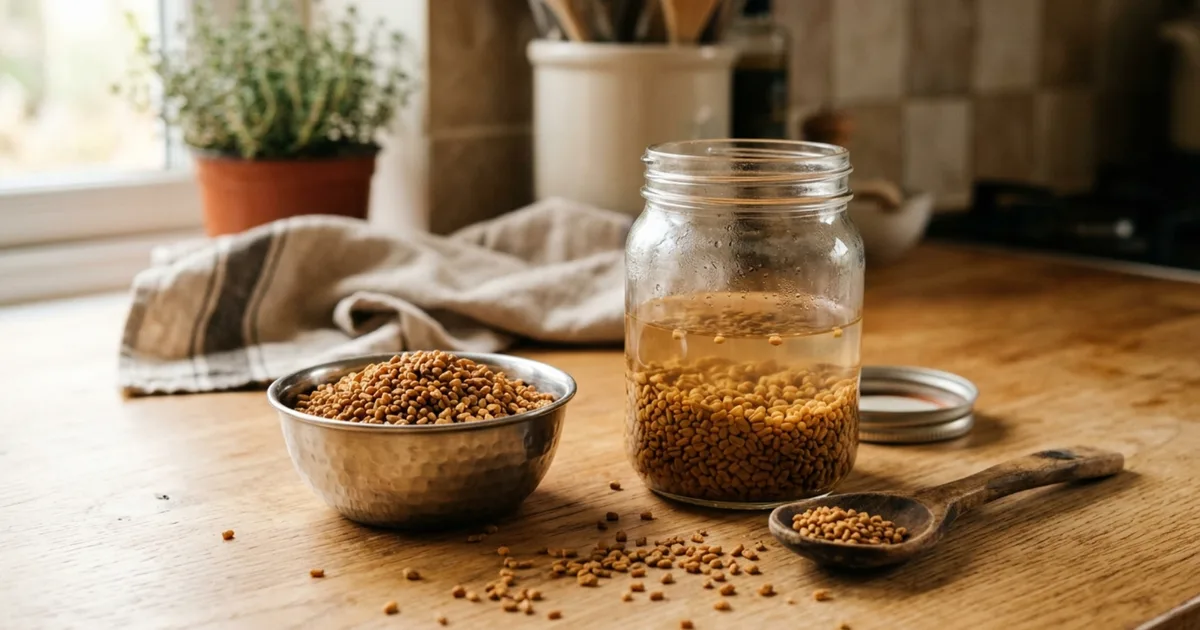
My tip: If you’re using fenugreek seeds for their fibre rather than just flavour, soak a teaspoon overnight in water and eat them plain or stirred into food the next morning. Soaking softens the seed and makes the fibre easier to eat in a real quantity, rather than the tiny pinch that goes into tempering.
Sprouted fenugreek seeds are another option — soak for a day, drain, and leave covered for another day or two until small sprouts appear. Sprouted methi has a milder, less bitter flavour and works well in salads or lightly sautéed as a side, and it’s a fairly common way to eat a larger quantity of the seed without the sharp bitterness of the dry version.
Fenugreek tea, made by steeping a teaspoon of seeds in hot water for several minutes, is another traditional preparation, particularly around breastfeeding — though given the evidence above, it’s worth treating as a mild, low-risk habit rather than a guaranteed fix.
Who should be careful with fenugreek
Normal cooking amounts of fenugreek — the kind used to temper dal or flavour a curry — are considered fine for most people, pregnancy included. The caution is specifically about concentrated doses: fenugreek supplements, capsules, or large quantities of seed or extract. NCCIH states that fenugreek is not considered safe during pregnancy in amounts greater than those found in food, citing concerns about birth defects at high doses, and fenugreek has documented uterine-stimulant effects in concentrated form, which is part of why it has also been used traditionally to try to induce labour. If you’re pregnant and fenugreek is part of your everyday cooking, that’s generally not a concern — but fenugreek supplements or capsules during pregnancy are a different question, and one worth asking your midwife or OB-GYN about directly rather than guessing.
Two other groups should be cautious. If you take warfarin or another blood-thinning medication, fenugreek may increase bleeding risk — LactMed notes it can interact with warfarin to cause bleeding, and this is consistent with other pharmacology sources. If you take insulin or other diabetes medication, the same blood-sugar-lowering effect that makes fenugreek interesting for diabetes management also means it can push blood sugar down further than intended when combined with medication — talk to your doctor before adding regular fenugreek supplementation on top of a treatment plan. Fenugreek is also a legume, so people with peanut, chickpea, or other legume allergies should be alert to possible cross-reactivity.
Frequently asked questions
Is fenugreek actually proven to increase breast milk supply?
Not conclusively. Some trials show a real increase in milk volume, others show no meaningful difference, and major reviews from NIH’s NCCIH and LactMed both describe the evidence as mixed or low-certainty. It’s a reasonable, low-risk thing to try, but not a guaranteed fix.
Does fenugreek actually lower blood sugar, or is that folk wisdom?
This claim holds up well. A 2023 meta-analysis of 10 randomized controlled trials (706 people) found fenugreek meaningfully reduced fasting blood glucose and HbA1c in people with type 2 diabetes or prediabetes, and the mechanism — galactomannan fibre slowing carbohydrate absorption — is well documented in lab research too.
Is fenugreek safe during pregnancy?
Normal culinary amounts used in everyday cooking are generally considered fine. Concentrated fenugreek supplements or large seed quantities are a different matter — NCCIH advises against amounts beyond what’s found in food during pregnancy, due to uterine-stimulant effects at high doses. Check with your midwife or OB-GYN if you’re considering a fenugreek supplement specifically.
Can I take fenugreek if I’m on diabetes medication or blood thinners?
Speak to your doctor first. Fenugreek can add to the blood-sugar-lowering effect of insulin or other diabetes medication, and it has documented interaction risk with warfarin. This matters more for concentrated supplement doses than for a teaspoon used in cooking, but it’s still worth flagging to whoever manages your medication.
What’s the difference between methi seeds and methi leaves?
They’re used quite differently. Methi seeds are the small, hard, bitter spice covered in this article, typically used in tempering or ground into spice blends. Methi leaves (fresh fenugreek greens) are a leafy vegetable, cooked more like spinach or mustard greens, with a different nutritional profile and a much milder bitterness.
How much fenugreek is a reasonable daily amount?
There’s no official guideline for fenugreek specifically. Most research trials use doses well above typical cooking use — often 5g or more of powder or seed daily. For everyday culinary use, a teaspoon or so worked into cooking or soaked and eaten is a reasonable, traditional amount. Anything beyond that, especially in supplement form, is worth discussing with a doctor first.
References
- USDA FoodData Central — Spices, fenugreek seed. fdc.nal.usda.gov
- The Effect of Fenugreek in Type 2 Diabetes and Prediabetes: A Systematic Review and Meta-Analysis of Randomized Controlled Trials (2023). International Journal of Molecular Sciences, 24(18), 13999. pmc.ncbi.nlm.nih.gov
- Hassani SS, et al. (2019). Effect of Fenugreek Use on Fasting Blood Glucose, Glycosylated Hemoglobin, Body Mass Index, Waist Circumference, Blood Pressure and Quality of Life in Patients with Type 2 Diabetes Mellitus: A Randomized, Double-Blinded, Placebo-Controlled Clinical Trial. Galen Medical Journal. pmc.ncbi.nlm.nih.gov
- National Center for Complementary and Integrative Health (NCCIH) — Fenugreek. nccih.nih.gov
- Drugs and Lactation Database (LactMed) — Fenugreek. National Library of Medicine. ncbi.nlm.nih.gov
- Bumrungpert A, et al. (2018). Effects of Fenugreek, Ginger, and Turmeric Supplementation on Human Milk Volume and Nutrient Content in Breastfeeding Mothers: A Randomized Double-Blind Controlled Trial. pubmed.ncbi.nlm.nih.gov
Found this helpful?