Homemade Apple Pie: A Classic Double-Crust Recipe
Key takeaways
- This is a dessert, not a health food — the fibre and vitamin C in the apples don't offset the sugar, butter, and refined flour in the crust, whatever some recipe sites imply.
- Letting the sugared apple mixture sit for 10 minutes and draining off some liquid is the single best fix for a soggy or runny filling.
- The full 2-hour cool isn't optional — the filling is still setting during that time, not just cooling to a nicer serving temperature.
- Cinnamon's effect on blood sugar is real in some studies but small and inconsistent — don't count on a slice of pie for any meaningful benefit.
Ingredients
Check off ingredients as you go
Apple pie was never really part of my own family’s baking tradition growing up in India, but it’s become one of the first things I learned properly once I started baking more seriously in Finland — partly because Finnish apples in autumn are excellent, and partly because it turned out to be far more forgiving than I expected once I understood a couple of things the recipe cards never mention.
Why this recipe works
Two things separate a good apple pie from a soggy, runny one, and neither is really about the apples themselves. First, letting the sugared apple mixture rest for ten minutes before filling the crust draws out excess liquid you can drain away, rather than baking it all into the pie — this alone fixes most “watery pie” complaints. Second, the full two-hour cool afterward isn’t just about serving temperature; the cornstarch-thickened filling continues to set as it cools, and a slice cut too early will run even from a pie that baked perfectly.
I’ll also be straightforward about something a lot of recipe sites gloss over: this is a dessert. Apples genuinely are a nutritious fruit, but wrapping them in a butter-and-flour crust with two-thirds of a cup of sugar doesn’t inherit that nutrition — the fibre, vitamin C, and antioxidants in the fruit are real, but they don’t cancel out the sugar and fat in the rest of the pie. It’s a lovely thing to make and share; it just isn’t a health food, and treating it as one does readers a disservice.
Ingredients and how to make it
Follow the checklist and steps above. If you’d rather make the crust from scratch instead of using store-bought, a standard double-crust ratio is 2½ cups (300g) flour to 1 cup (226g) cold butter, cubed, plus a pinch of salt and 6–8 tablespoons of ice water — worked together just until it holds, then chilled for at least 30 minutes before rolling. Overworking pie dough is the most common reason it turns out tough rather than flaky.
A mix of tart and sweet apples gives a rounder flavour than one variety alone — tart apples (Granny Smith, Braeburn) hold their shape better through baking, while sweeter ones (Honeycrisp, Gala) soften more and add natural sweetness.
My tip: If your oven runs hot or your crust browns quickly, a strip of foil over just the edges (leaving the center exposed) after the first 20–25 minutes stops the rim from over-browning before the center of the pie is properly baked through.
Variations
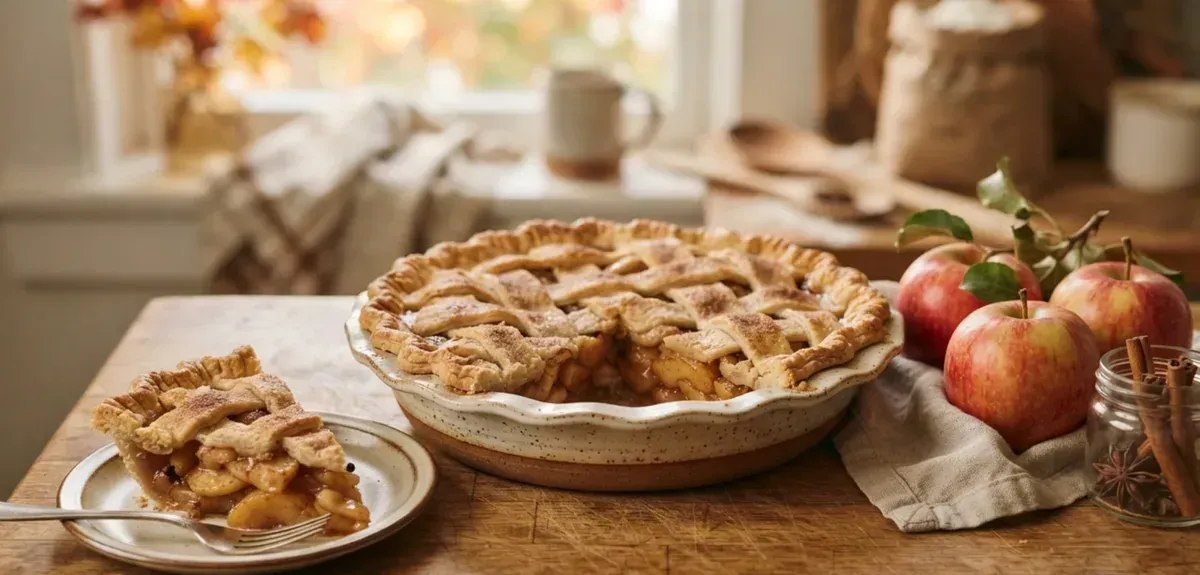
Lattice top. Cut the second crust into strips and weave them over the filling instead of laying it flat — it looks more impressive and lets more steam escape, which can help further with a soggy filling.
Spiced further. A pinch of ground cloves or allspice alongside the cinnamon and nutmeg gives a deeper, more autumnal flavour.
Mixed fruit. Swapping a couple of the apples for pear or a handful of fresh cranberries works well with the same spice mix and thickening method.
If you’d rather turn a big bag of apples into something that keeps for weeks rather than a few days, our homemade apple jam is a lower-effort way to use the surplus.
Storage
Apple pie keeps at room temperature, loosely covered, for up to 2 days, or in the fridge for up to 5 days. It also freezes well — either baked and cooled completely, or unbaked and frozen solid before wrapping tightly, baking straight from frozen with extra time added.
Frequently asked questions
Why is my pie filling always runny?
Almost always because the filling didn’t get the chance to release and shed some of its liquid before baking, or the pie was cut before the full cooling time. Both fixes are in the steps above, and together they solve most soggy-pie problems.
Do I need to pre-bake the bottom crust?
Not with this method, since draining the filling and cooling fully afterward addresses most of the sogginess. If you want extra insurance, blind-baking the bottom crust for 10 minutes before filling does help, especially with very juicy apples.
Can I make this with a store-bought crust?
Yes — it’s what I use more often than not on a weeknight. The filling and thickening technique matter more to the final result than whether the crust is homemade.
Can I freeze apple pie?
Yes, either baked or unbaked. Wrap it tightly to prevent freezer burn, and if baking from frozen, add roughly 15–20 extra minutes and tent the edges with foil from the start.
Is apple pie actually good for you?
It’s a dessert made with a genuinely nutritious fruit, which is a nicer starting point than most desserts — but the sugar, butter, and refined flour in the rest of it mean it belongs in the “occasional treat” category, not the “healthy snack” one. If you want the fruit without the crust and sugar, homemade apple juice or just eating the apple fresh gets you closer to the actual nutritional benefits.
Source: USDA FoodData Central
Found this helpful?